Showing posts with label unit 1. Show all posts

Tuesday, 5 December 2017

Marvels – The Punisher anaylsis


Colour
Death
Blood- Danger
Costume + pops
Use of costume + props link back to the colour
Location
HQ-(Headquarters) is located in the basement – It is full of different high quality computers and gadgets and they are used to operate CCTV cameras that are used for watching over his family. Also he is hiding from people that are after him and his family that’s why he is trying to keep a low profile. The punisher doesn’t want anyone to know that neither he nor his partner is alive otherwise is could affect their mission.  
Lighting
The lighting is dim throughout because of the genre of the series. It gives impact to how the audience feels connected to the characters of the show and creates intensity.
Sound
Creepy no- diegetic
Music- There is a general undertone of theatrical music that has a build up as stories within the episode unravel.


Each theme and setting has its own style of music played. Each expected and stereotypical but still creates an impacting atmosphere.
Because there is a lot of action in the show, there are a lot of loud sounds and machinery in the show which makes scenes seem bigger.
Natation 
Camera angles 

Tilt-

Moving shots

Editing

Eye line match

Match cuts


Thursday, 30 November 2017

Prison break


Level 2 Media Unit 1C: Narrative and Genre Key Terms

Non Linear Narratives

Victim: Lincoln 

Hero: Michael (Lincoln’s brother)


Helper: Fernando Sucre was the one of helping Michael Scofield to get his older brother out of prison and also helping him to start a new life knowing it would be a hard process. Michael knows where to escape and where all the exits are in the prison but in order to escape, he needs all the help that he possibly can get from all the others.


Parallel narrative is a story structure when the director incorporate two or more separate narratives that it is linked by the main frequent character.


Flashbacks: The Flashback is when Michael’s brother Lincoln was being sentenced to death and had to talk to his brother who were in prison. This tells us that his brother was sentenced for something he didn’t do and now he will be killed because his brother Lincoln was blamed for it and charged for the crime.


The Flash-forward is how they are planning to break out through the prison to go to their family and for Lincoln, to get back to how his life was before he got in. This scene is speed up to see what is going to happen after. There is another flash-forward using the same tactic but this time they release what the tattoo on his body is which represents a map of all the tunnels of the prison to get out but in a secret method so no-one can interpret it or understand what his plans are.


Time & Space:  One of the Set takes place in a tattoo store in the first scene.  This Set is beginning in the dark then changes to a hostage in a bank in the daylight. It then ends up in the jail cell on the same day. Michael didn’t plan to steal money from the bank, he just wanted to pretend robbing the bank only to be arrested hoping to be reunited with his brother in jail.  The main story is set in the prison because the episodes of the story line are based on him getting his brother out and conduct a ‘prison break’.


Cliff-hanger: The cliff-hanger by making the end happening unexpectedly is to trigger a powerful scene and creates uncertainty. The scene is when Michael received a secret about his tattoo which isn’t shown to the camera but we know this because they use non-diegetic sound and we can see that he’s in a tattoo place. Also when the woman asked him to see it again, he doesn’t agree to it as he is worried that she could work out his plan. Throughout his time in prison, he dropped secretive swans made of paper within each of them have a drain hole and this could be a potential marking for the ‘prison break’.


Editing (continuity vs discontinuity): Matched cuts / jump cuts, the story continues but conflicts between each setup is used to create flashbacks to refer to the audience. However throughout the episode, the audience can see the editing is used through flashbacks. Matched cuts are being used to perform this shots and jump cuts are being used to jump from one scene to another. The producer  also uses transitions and close ups; there is one particular shot where they closed up on guy’s face being scared and then it overturned to the iris of his eye and then to a close up to the barrelled hole of a pistol.


Chronology starts from the beginning in the tattoo place but do not know where the tattoo place is. This when Michael Scofield is getting arrested for no reasons apart from trying to get lock in in the same prison as his brother to help to break through. It shows flashbacks and then the story still goes forward to where he lift us.


Subjective & Objective: The beginning is based on personal feelings because the two characters go to the prison for a positive purpose and you can see/read his sensations from his face through the close up shot when he gets into prison.


Mode of address & Tone: The tone is slow and very correct, the mode that they use is mainly between the two characters. The storyline is delivered through dialogue between each character and change of scene throughout the episode. Throughout this episode, there are multiple conversations which use slow tone and oppressing mode of address which creates emotions. They also use sad music in the background.


Type/Genre: The actions of the film is a cross genre due to the seasons when It has been filmed.


Role of audience: We observe the information and consume it has a hypodermic needle.


Role for producer: This informs the audience and determines how they’re getting out of the situation and how they leave this on a cliff- hanger.


Camerawork/Shots: During the course of the episode, the use of multiple shoulder shots which are normally used when somebody is having a conversation. They use multiple jump cuts to go to the next part of the season or scene. The flashbacks and flash-forwards shows us what it is going to happen in the next scene usually similar to the previous one. 

Tuesday, 7 November 2017

Audience Theory: From Passive to Active


Audience Theory: From Passive to Active

How do audiences “read”, interpret, and interact with media products?


A bit of history

When Media Studies first started as a “serious” discipline, the focus was very much with the effects that the media had on the audience. This approach saw the audience as a passive mass, being brainwashed by the messages that flooded them from TV, newspapers, films, the radio and so on.  In effects theory, the media are powerful, negative forces who control the masses.  The media is seen as a hypodermic needle , injecting our helpless minds with messages which we take on board fully.  The effects model is still in evidence today, particularly in tabloid newspapers who construct moral panics around the latest buzz in the media- rap music videos, horror movies, Facebook and so on. 


Moral Panics

Moral panics happen when members of a society and culture become outraged, fearful and upset by the challenges and menaces posed to 'their' accepted values and ways of life, by the activities of groups defined as deviant.  These could be violent extremists, teenagers, or an organisation / idea such as the internet, or facebook.


What recent examples can you think of moral panics?


A more active audience?

In more recent years in Media Studies, there has been an increasing acceptance that the audience didn’t just operate as a big “mass”.  This recognised that people from different types of backgrounds had varying “readings” or interpretations of the media.  This approach sees the audience as active, rather than passive, making their own meaning.  It is known as uses and gratifications theory. The audience has a set of needs which the media in one form or another meet.   Blumler and Katz in 1974 identified four broad needs that were fulfilled by television viewers:

  • Diversion- a form of escape or release from everyday pressures
  • Personal relationships- companionship through identifying with TV characters and sociability through discussion about TV with other people
  • Personal identity- the ability to compare one’s own life with the characters and situations portrayed and explore individual problems and perspectives
  • Surveillance- information about “what’s going on” in the world.


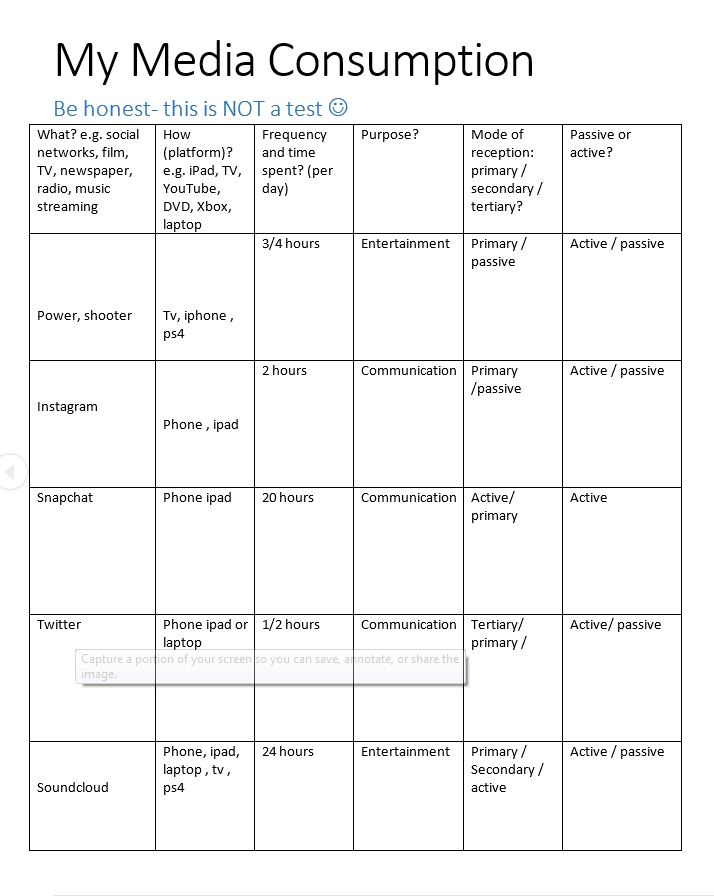
Modes of reception

As we have recognised that audiences are often active, rather than passive, there have been three modes of reception recognised.  These describe the ways in which we receive media messages:

Primary: The audience is fully absorbed with the media message, for example in a darkened cinema

Secondary: The audience is paying attention, but is also doing something else. For example eating their tea in front of the TV, whilst chatting to family

Tertiary: The audience has minimal engagement with the media, for example, barely noticing billboard advertisements whilst on the bus.


A 21st century approach to audience: Media Studies 2.0?

You may have heard of the term Web 2.0 to refer to the internet in its most recent form as creative and highly interactive.  The Media writer David Gauntlett has suggested a possible parallel in Media Studies 2.0 (2006).  Gauntlett suggests that in today’s Media world, the lines between producers and audiences have become blurred, and that now all of us are media experts.  He recognises with the predominance of the internet and converging media industries, that YouTube, Facebook, Wikipedia and similar have potentially made all of us producers, active audiences, and sophisticated participators.  In these examples, it is the audience who has control over the message, not a big institution.  Even the larger, well-established institutions such as the BBC have picked up on this spirit of audience as participator, with the predominance of interactive services, blogs and the like.  The following quotation summarises Gauntlett’s Media Studies 2.0 very nicely:


“..the arrival of new media within the mainstream has had an impact, bringing  vitality and creativity to the whole area, as well as whole new areas for exploration (especially around the idea of “interactivity”).  In particular, the fact that it is quite easy for media students to be reasonably slick media producers in the online environment, means that we are all more actively engaged with questions of creation, distribution and audience.”


Friday, 13 October 2017

media sectors


Media sectors
Moving image
Audio
Websites (online)
Gaming
Publishing
Give 5 examples of media products for each sector:
Moving image
1. tv shows
2. Movies
3. on Demand
4. Advert
5. Animation
Audio
1. Voice over
2. Mp3
3. CDs
4. vinyl
5. casket player
Websites
1.  Wikipedia
2. Blogs
3. Social media
4. Online
5.
Gaming
1. PS VITA
2. XBOX
3. PS4
4.  Games boys
5. Nintendo
Publishing
1. News paper
2. Books
3. articles
4.
5.
Media processes
Write down 5 examples of media processes for each stage:

Pre-production
1. Story board
2.  cool sheet
3. Scrips
4.  Audio Feedbacks
5.  Casting
Production
1. Editing
2. Sound
3. Special effects
4.
5.


Post-production
1.
2.
3.
4.
5.

Tuesday, 3 October 2017

Advantages & Disadvantages of cd and vinyl

Advantages & Disadvantages  of cd and vinyl

Disadvantages 
  • Vinyl is harder to maintain than CDs, and should ideally be stored in temperature- and humidity-controlled environments. (However, air conditioning, perhaps with a dehumidifier, is almost always sufficient.) Mold can grow on vinyl and may permanently damage it and its sleeve, and can spread from record to record.
  • Vinyl is very easy to damage during playback. Any scraping of the surface can permanently compromise the sound quality.
  • Surface noise, while often inaudible, will always be present and measurable, even on a brand new LP.
  • The sound quality of a record cannot be determined until you play it, increasing the risk of the purchase. Even brand new, sealed LPs can have significant pressing and warping problems that may make it unusable for listening purposes.
  • Certain parameters of vinyl recording and playback - notably, the vertical tracking angle (VTA) and the stylus rake angle (SRA) - were never formally standardized, and vary considerably between records. Distortion from these effects is generally considered extremely audible and very difficult (if not impossible) to correct.
Advantages
It isn't the LPs that are better than the CDs, not at all. CDs are technically far superior to LPs for reproducing sound. It's the music that was on the LPs that's better than the music that is on CDs nowadays.

CDs can reproduce sounds within 3 times the dynamic range of a CD. With far less distortion, much lower and also higher frequencies.

The cover artwork and the listening and care that goes along with listening to the analogue medium is also important as was already mentioned.

You take the recording home and normalize it, which means just making it as loud as possible without adding distortion. You listen to the recording on your good stereo in the living room and are very satisfied.

unit 4 podcast